Download Free A History of Art in Africa (2nd Edition) PDF Ebook
Download A History of Art in Africa (2nd Edition) Free PDF eBook
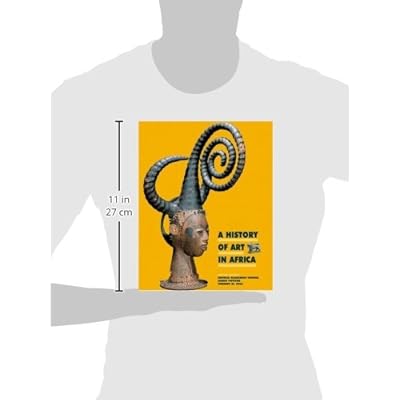
by
--- DOWNLOAD LINK ---
About the Author MONICA BLACKMUN VISONA is Assistant Professor of Art History at the University of Kentucky. Her publicationsfocuses upon the arts of the Lagoon Peoples and upon the larger issues of contemporary African art. ROBIN POYNOR is Professor of Art History at the University of Florida. He is a specialist on Yoruba arts in Africa and the New World andis a regular contributor to African Arts. He hasserved as both consultant and guest curator for numerous exhibitions. HERBERT M. COLE is Professor Emeritus of Art History at the University of California, Santa Barbara and a recipient of the Lifetime Achievement Award by the Arts Council of the African Studies Association. He has published numerous books and exhibition catalogues. The closing chapterof this book was written by Michael Harris, Associate Professor of African American Studies atEmory University. The preface was written by Roland Abiodun, Professor of Art Hisotry at Amherst College, and the introduction was written by Suzanne Preston Blier, Allen Whitehill Clowes Professor of Fine Art and Africam American Studies at Harvard University. Read more Excerpt. Reprinted by permission. All rights reserved. PREFACE SINCE ITS INCEPTION LAST CENTURY, the field of African art studies has been vexed by the problem of cross-cultural translation. How can one, for example, meaningfully present to a Western audience two radically different Yoruba works? The ako is a seated, life-like, life-sized, human-garbed burial effigy carved in wood which is painted to enhance its mimetic qualitiesa social and psychological reconstruction of the dead. The aale is a hanging, seemingly abstract sculptural construct made from a bit of red rag, a slipper, a metallic soup spoon, and some sticksa deterrent impregnated with ase, the catalytic life-force, to stop thieves and ward off unauthorized persons from one's property. Both of them could have been created around the same period, possibly even by the same artist. Quite often, our inadequate preparation to grapple with seeming incongruities of this kind has led to many misconceptions, bizarre conclusions, and at other times, brilliantly presented but untenable theories on African art. This simple comparison reveals how, in considering African art, conventional Western art historical assumptions of stylistic progression and individual artistic identity are called into question. To make any substantial progress in dealing with the problems of cross-cultural translation as it pertains to the study and presentation of African art, we must consider both perspectives: the indigenous as well as the Western. While it may have been useful to utilize only Western theoretical paradigms in the study of African art history and aesthetics in the early twentieth century, it has now become imperative to search carefully within the African cultures in which the art forms originate and to use internally derived conceptual frameworks in any critical discourse on African art. There are, however, difficulties in translating this theoretical position into practice. The study of African art, having begun within the discipline of anthropology, inherited some pertinent and vexing questions. Among these is the false assumption that Western scholars can fully understand and interpret the cultures of other peoples only by using their Western cultural notions, values, and standardsa claim that cannot be divorced from a longstanding Western, imperialistic involvement in Africa. In the traditional discipline of art history, the importance of African art has hardly advanced beyond that of catalyst and sanction for the revolutionary goals of European artists such as Pablo Picasso at the beginning of the twentieth century. Thus, Roy Sieber, a leading scholar in African art, has noted that an insufficient understanding of African art has caused it 'to fall prey to the taste of the twentieth century.' In a bold and innovative manner, the authors of this textbook have taken a major step toward the goal of fashioning a new 'lens'one which appreciates the methodology of the finest traditions in Western art history but which also recognizes the need to critically examine, modify, and expand. This will enable scholars to deal with the special challenges presented by the visual art traditions of predominantly non-writing, pre-colonial peoples of Africa. To illustrate my point, let us consider the question of anonymity in African art, a problem exacerbated by the fact that traditional African artists do not sign their works in the way artists in many contemporary Western societies do. Western audiences have become accustomed to appreciating and enjoying African works of art without knowing the names of their creators. Why should there be an interest in the issue of artists' identities now? Have we not read works by many scholars and even some 'African art experts' premised on the notion that supposedly rigid African traditions are oblivious or even hostile to notions of individuality itself? The situation is complicated further when we consider how some art dealers and collectors view the issue of anonymity. A collector has been quoted as saying, 'I am completely enchanted by the artist's anonymity. Not knowing the artist is something that gives me enormous pleasure. Once you hear who made it, it ceases to be primitive art.' To continue with the example of the Yoruba of West Africa, research confirms that Yoruba people not only know the value of the authorship of works of art, but that they, in fact, celebrate it through the literary genre known as oriki (citation poetry). There are, of course, other appropriate traditional contexts and occasions in which an artist's name may be heard and used. They include child-naming, installation and burial ceremonies, blessing and healing rituals, and important family gatherings. The myth of anonymity was constructed and reinforced by many early Western researchers who believed that, although the artifacts and the traditional thought systems (their raison d'etre) belong to Africans, the interpretation of such works and the theorization of African art would always be a Western prerogative. Many scholars today (including the authors of this volume) are, however, more cautious about not repeating that same old error; i.e., believing that if the definitions of art or artistic procedures in other cultures do not take the forms with which we in the West are familiar, they must be lacking. In considering the question of anonymity, it is important to note some reasons that the Yoruba may not publicly or openly associate specific art forms with the names of their authors. Often, names given at birth are closely linked to and identified with the essence of one's personality and destiny called ori inu (inner spiritual head), which in Yoruba religious belief, determines a person's success or failure in this world and directs his or her actions. In Yoruba society, the act of calling out a person's given names generally functions to differentiate individuals. In their religious system, naming also is believed to have the ability to arouse or summon a person's spiritual essence and cause him or her to act according to the meaning of those given names or in some other way desired by the caller. This is the basis of the Yoruba saying, oruko a maa ro'ni: 'one's name controls one's actions.' For example, a name like Maboogunje is actually a plea, the full sentence being 'Ma(se) ba oogun je,' the translation of which is 'Do not render medication ineffective.' Yoruba naming ceremonies and practices are among the most elaborate and sophisticated know anywhere. In addition to serving as identification, a name also incorporates elements of family history, beliefs, and the physical environment. With every naming, there begins a corresponding oriki (citation poetry), which grows with an individual's accomplishments. Thus, leaders, warriors, diviners, and other important personages, including artists, are easily identified by their oriki, which chronicles intricate oral portraits of all that is notable in their character and history. To illustrate, let me cite a part of the oriki of Olowe, one of the greatest traditional Yoruba sculptors of the twentieth century: Olowe, oko mi kare o Olowe, my excellent husband Aseri Agbaliju Outstanding in war. Elemoso Elemoso (Emissary of the king), Ajuru Agada One with a mighty sword O sun on tegbetegbe Handsome among his friends. Elegbe bi oni sa Outstanding among his peers. O p'uroko bi oni p'ugba One who carves the hard wood of the iroko tree as though it were as soft as a calabash. O m'eo roko daun se ... One who achieves fame with the proceeds of his carving ... Ma a sin Olowe I shall always adore you, Olowe. Olowe ke e p'uroko Olowe, who carves iroko wood. Olowe ke e sona The master carver. O lo ule Ogoga He went to the palace of Ogoga Odun merin lo se libe And spent four years there. O sono un He was carving there. Ku o ba ti de'le Ogoga If you visit the Ogoga's palace, Ku o ba ti d'Owo And the one at Owo, Use oko mi e e libe The work of my husband is there. Ku o ba ti de'kare If you go to Ikare, Use oko mi i libe The work of my husband is there. Ku o ba ti d'Igede Pay a visit to Igede, Use oko mi e e libe You will find my husband's work there. Ku o ba ti de Ukiti The same thing at Ukiti. Use oko mi i libe His work is there. Ku o li 0lowe l'Ogbagi Mention Olowe's name at Ogbagi, L'Use In Use too. Use oko mi i libe My husband's work can be found Ule Deji In Deji's palace. Oko mi suse libe 1'Akure My husband worked at Akure. Olowe suse l'Ogotun My husband worked at Ogotun. Ikinniun There was a carved lion Kon gbelo silu Oyibo That was taken to England. Owo e o lo mu se. With his hands he made it. The oriki of Olowe was collected by John Pemberton III in 1988 from Oluju-ifun, one of Olowe's surviving wives, and has been found to be instrumental in reconstructing his life and work. Clearly, neither Yoruba culture nor the Yoruba system of storing and retrieving important information about their artists is impoverished. We do know, however, that artists may become vulnerable targets of unknown malevolent forces because of their profession and special position in the traditional community. For this reason, until relatively recent times, artists rarely revealed their full given names to strangers. It is, therefore, not surprising that many outstanding Yoruba artists whose works have been collected and studied by researchers have been identified in scholarly literature only by their nicknames or bynames such as, for example, Olowe Ise (meaning Olowe from the town of Ise);... --This text refers to an out of print or unavailable edition of this title. Read moreAmazon com A History of Art in Africa 2nd Edition 0076092100003 Monica Blackmun Visona Robin Poynor In the traditional discipline of art history A History of Art in Africa Second Edition is the only comprehensive art historical survey of the African continent to incorporate discussions of contemporary art A History of Art in Africa Second Edition Africa Art and History History of Art in Africa A 2nd Edition Buy History of Art in Africa 2nd edition History Geography Textbooks A History of Art in Africa Second Edition History of Art in Africa A 2nd Edition History of Art in Africa A 2nd Edition Author Monica B Visona Robin Poynor Herbert M Cole Preston Biler A History of Art in Africa 2nd Edition 2nd Edition by Herbert M Cole Monica Blackmun Visona Robin Edition Monica Blackmun Visona Robin Poynor Buy History of Africa on Amazon com of the basic history of the entire continent of Africa in a way that book history of Africa 2nd edition A History Of Art In Africa 2nd Edition may not make exciting reading but Applied Numerical Methods With Matlab Solution Manual 3rd Edition is packed A History of Art in Africa Second Edition Africa Art and History An Introduction 14 PART I From the Nile to the Niger 1 The Sahara and the Maghreb 2 A HISTORY OF ART IN AFRICA 2ND EDITION A HISTORY OF ART IN AFRICA 2ND EDITION A HISTORY OF ART IN AFRICA 2ND EDITION A HISTORY OF ART IN AFRICA 2ND EDITION A HISTORY OF ART IN AFRICA 2ND EDITION A HISTORY OF ART IN AFRICA 2ND EDITION A History of Art in Africa A History of Art in Africa Second Edition schema description Africa Art and History A HISTORY OF ART IN AFRICA 2ND EDITION A HISTORY OF ART IN AFRICA 2ND EDITION A HISTORY OF ART IN AFRICA 2ND EDITION A HISTORY OF ART IN AFRICA 2ND EDITION A HISTORY OF ART IN AFRICA 2ND EDITION A HISTORY OF ART IN AFRICA 2ND EDITION A HISTORY OF ART IN AFRICA 2ND EDITION A HISTORY OF ART IN AFRICA 2ND EDITION A HISTORY OF ART IN AFRICA 2ND EDITION A HISTORY OF ART IN AFRICA 2ND EDITION History of Art in Africa A 2nd Edition Africa Art and History An Introduction 14 Southern Africa PART V The Diaspora Prentice Hall PAPERBACK 0136128726 BRAND NEW W FAST SHIPPING This item is A History of Art in Africa 2nd Ed 2008 by Visona Monica B Poynor Robin Cole A History of Art in Africa 2nd Edition A History of Art in Africa 2nd Edition This comprehensive work considers the arts of Africa as art history Free Download A History of Art in Africa (2nd Edition) di eBook PDF.


Comments
Post a Comment